kiln-guides 6 min read
Kiln Firing Schedules: Bisque and Cone-6 Starting Points
Standard ramp-hold firing schedules for bisque (cone 04) and cone-6 glaze: slow, medium, and fast structures, why each stage exists, and when to adjust them.
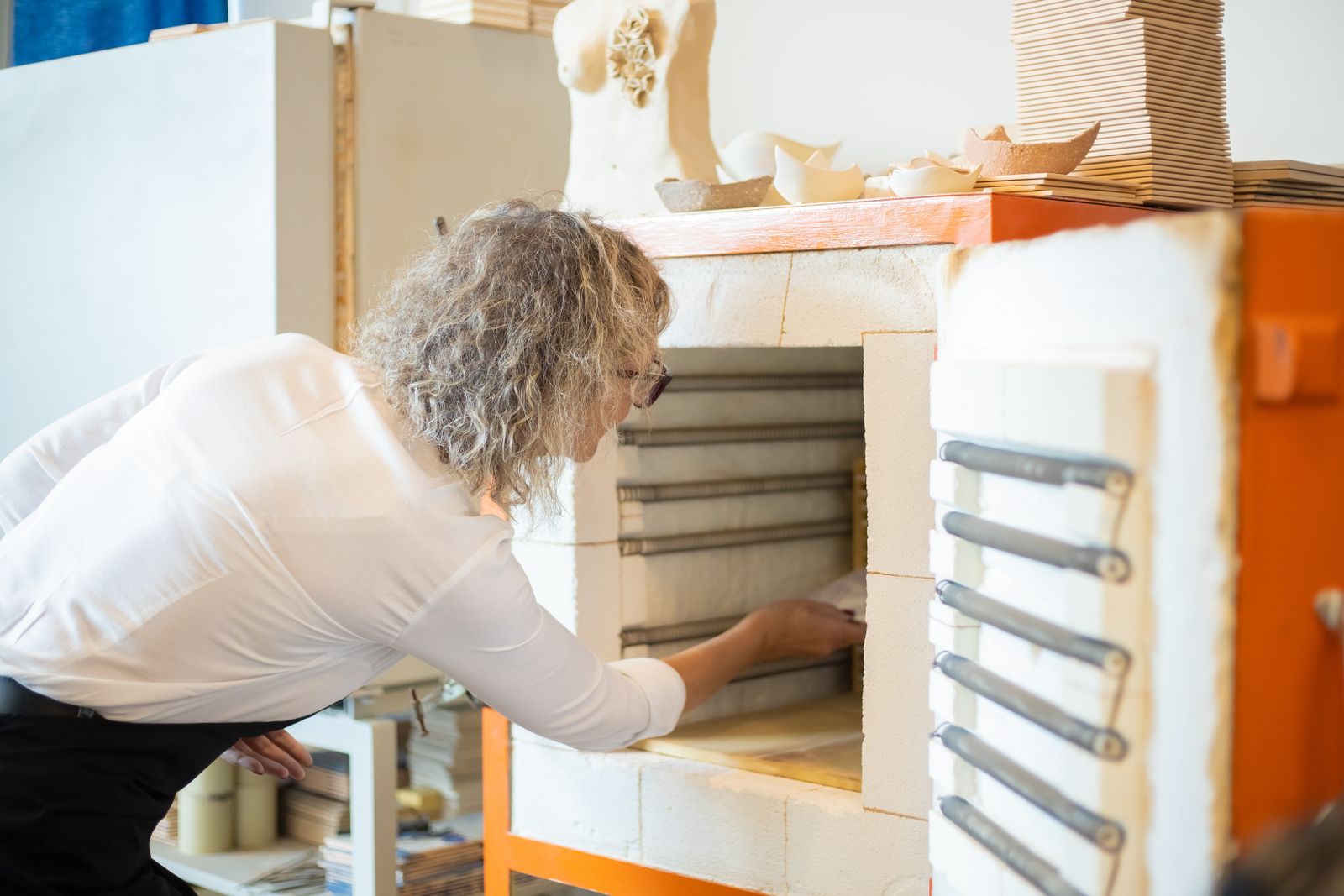
A firing schedule defines how fast the kiln climbs to temperature, whether there are any holds along the way, and how the kiln cools at the end. Electric kilns with digital controllers program schedules as a series of ramp segments, each with a rate (degrees per hour) and a target temperature. The schedules below are starting points based on manufacturer-published programs and common studio practice.
Two types of firings cover almost all studio work: bisque firing, which converts greenware to fired ceramic, and glaze firing, which matures glazes on bisqued work. They have different schedule requirements.
Bisque firing schedule (cone 04)
Bisque firing takes greenware (clay that has air-dried but not yet been fired) through the transformation to a porous fired ceramic. The critical constraint is the initial heating rate: greenware still contains physical water that must evaporate slowly enough to avoid steam explosions.
Standard slow bisque schedule:
| Segment | Rate | Target | Hold |
|---|---|---|---|
| 1 | 200°F/hr | 250°F | 30 min |
| 2 | 200°F/hr | 1100°F | 0 min |
| 3 | 150°F/hr | 1700°F | 0 min |
| 4 | 108°F/hr | 1945°F (cone 04) | 15 min |
Total firing time (including hold): approximately 12 to 15 hours in a fully loaded medium kiln.
Standard medium bisque schedule:
| Segment | Rate | Target | Hold |
|---|---|---|---|
| 1 | 250°F/hr | 250°F | 0 min |
| 2 | 300°F/hr | 1100°F | 0 min |
| 3 | 200°F/hr | 1700°F | 0 min |
| 4 | 108°F/hr | 1945°F (cone 04) | 15 min |
Total firing time: approximately 9 to 12 hours in a fully loaded medium kiln.
Source: Based on Skutt Kilns published bisque programs and L&L kiln schedule documentation. Verify with witness cones on first use with any new clay body or kiln.
Why each bisque segment exists
Segment 1 (slow climb to 250°F): Physical water in the clay evaporates in this range. Even thoroughly dried greenware retains moisture in the clay matrix. Firing too fast here causes steam to build inside the clay walls faster than it can escape, resulting in cracks or explosive delamination. Very thick pieces, handbuilt work with air pockets, and work that may be slightly damp need the slowest rate; bone-dry thin work can tolerate the faster medium rate.
Segment 2 (climb to 1100°F): Organic matter in the clay burns out in this range. Carbon from organic materials in the clay body must be fully burned off before the clay body closes up at higher temperatures. If carbon gets trapped, the result is dark spots (carbon coring) in the finished ware. This segment can proceed at a moderate rate once physical water has been fully evacuated.
Segment 3 (climb to 1700°F): The clay body begins converting from plastic clay to ceramic in this range. This segment proceeds at a steady rate.
Segment 4 (final approach at 108°F/hr): The standard Orton final rate matches the rate at which Orton cone temperature equivalencies were established. Firing at this rate through the final 200 to 400°F before the target cone matches how the cone will behave at its published temperature. The 15-minute hold allows the full load to equalize.
Cone-6 glaze firing schedule
Glaze firing loads bisqued (previously fired) ware. Because the physical and chemical water has already been driven off in bisque, the glaze schedule can climb more quickly from the start.
Standard cone-6 glaze schedule:
| Segment | Rate | Target | Hold |
|---|---|---|---|
| 1 | 300°F/hr | 1000°F | 0 min |
| 2 | 200°F/hr | 1500°F | 0 min |
| 3 | 150°F/hr | 2100°F | 0 min |
| 4 | 108°F/hr | 2232°F (cone 6) | 10-20 min |
Total firing time: approximately 8 to 10 hours in a fully loaded medium kiln.
Fast cone-6 glaze schedule:
| Segment | Rate | Target | Hold |
|---|---|---|---|
| 1 | 400°F/hr | 1000°F | 0 min |
| 2 | 250°F/hr | 1600°F | 0 min |
| 3 | 200°F/hr | 2100°F | 0 min |
| 4 | 108°F/hr | 2232°F (cone 6) | 10 min |
Total firing time: approximately 6 to 8 hours. Faster schedules produce different glaze surface qualities in some glaze chemistries; verify with witnesses before running at production volume.
Source: Based on Skutt Kilns and L&L published glaze firing programs. Adjust to your specific glaze and clay body.
Why each glaze segment exists
Segment 1 (fast initial climb): Bisqued ware can tolerate a fast initial rate because no steam pressure can develop. Early climbing through the first 1000°F is the main way to shorten a glaze firing without affecting glaze results.
Segment 2 (moderate climb to 1500°F): Some glaze materials melt and become active in this range. Carbon from organics in underglazes and organic colorants burns off. A moderate rate allows off-gassing to complete before the glaze seals over.
Segment 3 (careful climb to 2100°F): Glazes begin melting and flowing in the 1500°F to 2000°F range. Crawling, pinholes, and cratering problems often start in this zone. A slower rate gives the glaze time to settle, off-gas, and begin leveling before reaching full melt.
Segment 4 and hold: The final approach at 108°F/hr standardizes the rate at which the target cone level is reached. The hold at peak (10 to 20 minutes) gives the full load time to reach temperature and the glaze time to level. For tight kilns with dense loads, longer holds are better. For lightly loaded kilns, shorter holds or no hold may be adequate.
Cooling and quartz inversion
Most digital controllers manage only the heating schedule. Some controllers (including the Skutt KilnMaster and Bartlett Genesis) support controlled cooling segments as part of a ramp-hold program. Controlled cooling matters in two situations:
Quartz inversion (approximately 1063°F / 573°C during cooling): Crystalline silica in the clay body contracts rapidly at this point. Large pieces and work with significant thick-to-thin transitions are vulnerable to thermal shock cracking here. Slow cooling through this range (approximately 100°F/hr from 1150°F to 900°F) reduces stress. For typical functional studio ware (mugs, bowls), the kiln’s natural cooling is usually adequate. For large sculptural pieces or porcelain with dramatic wall thickness changes, controlled cooling through this range is worth adding.
Glaze fit and crazing: Some glazes prone to crazing benefit from a slow controlled cool from peak temperature through the glaze solidification range. This is a glaze chemistry issue rather than a structural one and is specific to particular glaze recipes.
Programming schedules into the controller
Both the Skutt KilnMaster and the Bartlett Genesis on the L&L e23T offer two modes:
Cone-fire mode: the simplest option. You select the target cone (04 for bisque, 6 for glaze) and a speed (slow, medium, fast). The controller runs its stored factory schedule for that cone and speed. Cone-fire mode is the right starting point for potters learning their kiln’s behavior.
Ramp-hold mode: manual programming. You enter each segment’s ramp rate and target temperature, plus any hold time. The schedules in the tables above can be entered as ramp-hold programs. Ramp-hold mode gives control over every variable in the firing; it is the mode experienced potters use once they have characterized how their kiln and materials respond.
For full details on controller features including cone-fire and ramp-hold modes, see the kiln controller guide. For cone temperature reference including the cone numbering system, see pyrometric cones explained. For individual kiln controller details, see the KM-1027 review and L&L e23T review.