kiln-guides 7 min read
Kiln Placement Guide: Clearances, Floors, and Siting
Manufacturer clearances for Skutt and L&L kilns, floor options, garage versus basement tradeoffs, and the real story on permits and homeowner's insurance.

Where the kiln goes determines how the rest of the studio is built. Unlike a pottery wheel, which can be moved, a kiln is effectively fixed once it’s positioned: the 240-volt circuit terminates there, the vent ductwork runs to a fixed exterior penetration, and the kiln itself (200 to 400 pounds fully assembled) does not move easily.
Getting placement right before installation avoids the most expensive corrections.
Clearance requirements
Both Skutt and L&L publish minimum clearances from the kiln body to nearby combustibles. These are the distances to the nearest wall, shelf, ceiling, or any other surface that could be damaged by radiant heat or physical contact during firing.
Skutt KM-series: 12 inches minimum from the kiln body to any combustible surface or wall. Skutt’s installation guide specifies this as the minimum; for a practical working installation, 18 inches is the standard recommendation to allow full lid opening, access to peepholes, and ventilation clearance.
L&L e23T: 18 inches from combustibles. L&L’s published guidance specifically requires 18 inches of clearance. This accounts for the e23T’s taller profile and the location of electrical connections.
Overhead clearance: check the lid swing arc before positioning the kiln near a low ceiling or overhead shelf. Top-loading kilns require vertical clearance above the lid for it to open fully. The KM-1027 requires approximately 24 inches of clearance above the lid edge; the e23T requires similar. Check your specific model’s dimensions.
Clearance in practice:
A 18-inch clearance on all four sides of a KM-1027 (23 inches wide in body) requires a space approximately 59 inches wide and 59 inches deep. The actual floor plan footprint including clearance is roughly 5 feet by 5 feet for the kiln zone alone. Plan your studio space with this footprint in mind before purchasing.

Floor surfaces
Concrete (bare or painted): the correct floor for any production kiln. Concrete is non-combustible, durable, easy to clean spills, and structurally sound under 200 to 400 pounds of kiln plus thermal mass of the load. No additional preparation is required unless the floor is significantly out of level (more than 1/4 inch over the kiln’s footprint).
Concrete with epoxy coating: acceptable and common in finished garages. The epoxy coating is not at risk from radiant heat at the distances required under the clearance rules.
Wood subfloor or wood flooring: possible with protection but not preferred. The kiln body does not radiate heat downward significantly in normal operation. The risk comes from a dropped piece of glowing ware during unloading, or a kiln shelf falling during lid inspection. A fired piece at glaze temperature will char or ignite unprotected wood.
Protection options for wood floors:
- Cement board (Hardiebacker 1/4-inch or 1/2-inch) under the full kiln footprint plus 18 inches on all sides
- Fiberglass kiln floor mat (sold by kiln dealers, purpose-made)
- Poured concrete slab pad specifically for the kiln zone
Carpet: not appropriate without full protection covering the carpet. A ceramic floor tile or cement board layer over the carpet is required at minimum.
Leveling: kilns must be level in both directions. An unlevel kiln causes glaze to run toward the low side of the kiln floor, potentially pooling against elements or the kiln wall. Use leveling shims under kiln legs; the kiln should not rock in any direction when loaded.
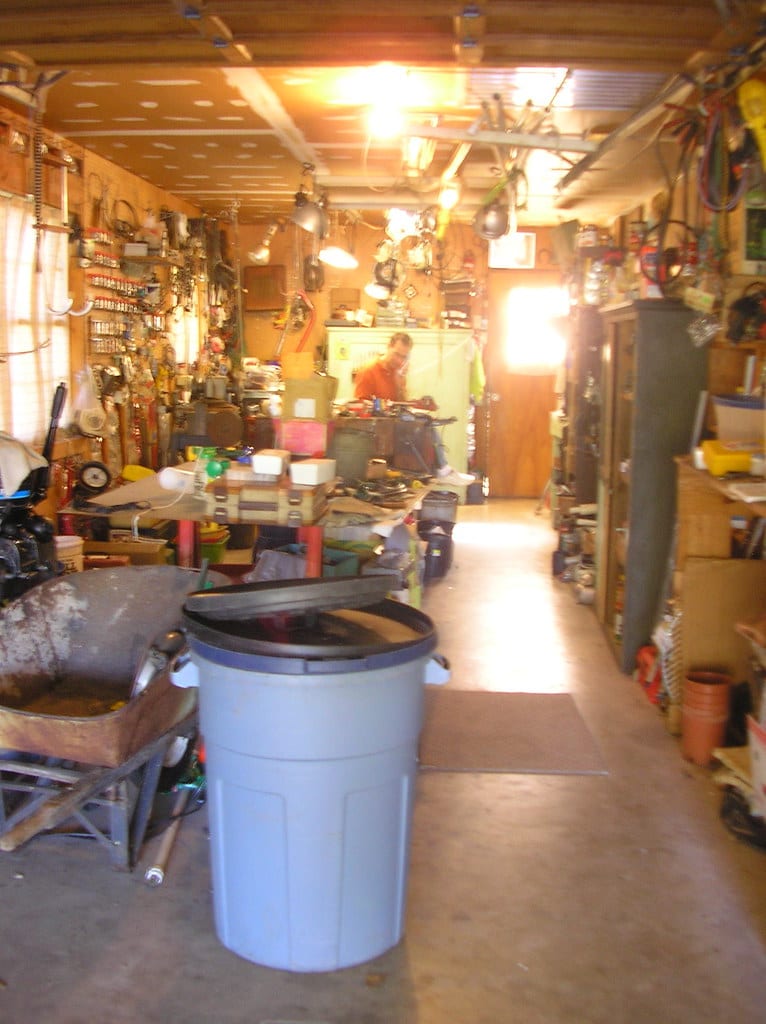
Garage vs. basement
Garage advantages:
- Concrete floor standard in most attached and detached garages
- Shorter run from main electrical panel (typically)
- Exterior walls make ventilation penetration straightforward: duct exits through the garage wall directly to outside
- Kiln fumes do not enter the living space above
- Garage doors provide natural ventilation for heat dissipation after firing
Garage considerations:
- Temperature extremes: in cold climates, an uninsulated garage in winter means the kiln starts at a lower ambient temperature. This does not affect firing results, but means a slightly higher electricity cost as the kiln heats from a colder starting point. It also means the studio is uncomfortable to work in during loading and unloading.
- Carbon monoxide and ventilation: a gas water heater or furnace in the garage competes with kiln vent exhaust for air. Verify the kiln’s downdraft vent exhausts fully outside, not recirculating into garage air.
Basement advantages:
- Controlled temperature year-round, more comfortable working environment
- Better security for tools and equipment
Basement considerations:
- Ventilation is harder: the downdraft vent must run ductwork from the kiln to a penetration through an exterior wall or up through the floor/ceiling assembly and out through the roof or exterior. Planning this run before kiln installation is essential.
- Humidity: basements with high humidity require moisture management before adding a kiln. The kiln’s firing cycle evacuates moisture from work but also produces humidity in the room from clay and glaze water.
- Floor drain: desirable for kiln wash water and glaze bucket cleanup. Most basements have one; garages may not.

Electrical circuit access and placement
The kiln’s electrical circuit terminates at a receptacle or hardwired connection. The circuit breaker controls power to the kiln. Position the kiln so the breaker is accessible without moving around or behind the kiln.
The NEMA 6-50 receptacle should be at a height where the kiln’s power cord reaches without strain (typically 18 to 36 inches above the floor for a kiln with an 8-foot cord). Avoid running the power cord under the kiln or along the floor where it could be stepped on or damaged by heat.
For the L&L e23T, which may be hardwired or use an NEMA L6-60R twist-lock receptacle, the connection point is typically at the back of the kiln near the bottom. Position the kiln so this connection is accessible without moving the kiln. The twist-lock receptacle does not disconnect accidentally, but the connection point must be reachable for any service inspection.
Building permits and code
The kiln itself is not a plumbing or structural element that requires a permit in most jurisdictions. The electrical work does:
Any new 240-volt circuit (regardless of what it powers) requires an electrical permit in most jurisdictions. The permit process includes an inspection of the wiring, breaker, and receptacle after installation. Your electrician will pull this permit as part of the job; confirm they include it in the quote.
Exhaust venting: in some jurisdictions, penetrating an exterior wall for ductwork may also require a permit. This is typically a simple review; ask your electrician whether the vent penetration falls under the electrical permit or needs a separate mechanical permit in your area.
HOA restrictions: some HOAs restrict visible exhaust vents on certain exterior walls, or prohibit commercial activity (including pottery sold from home) in residential units. Check CC&Rs before installing.
Homeowner’s insurance
Standard homeowner’s policies cover personal property and hobby equipment against fire, theft, and casualty. They typically do not cover business equipment or business liability. A kiln used for personal pottery is usually covered under a standard policy. A kiln used to produce pottery for sale, or used in any teaching activity, changes the classification.
Options:
- Hobby rider: some insurers offer a rider for hobby equipment including craft studios, at modest cost.
- Home-based business rider: required if any items produced are sold. Typically $50 to $200 per year.
- Business owner’s policy (BOP): full business liability coverage, appropriate if you teach or sell. More expensive but necessary for anything beyond personal use.
Contact your insurer before installation. Ask specifically: “I am installing an electric pottery kiln in my garage for personal use. Is this covered under my current policy, and is there anything I need to disclose?”

For ventilation systems and where they exit relative to the kiln, see the kiln ventilation guide. For the electrical circuit requirements by model, see kiln electrical requirements. For the full kiln review including dimensions and floor space requirements, see the KM-1027 review, KM-1018 review, and L&L e23T review.