kiln-reviews 6 min read
L&L e23T Review: Hard Ceramic Element Holders, Tested
The L&L e23T fires to cone 10 in 6.7 cubic feet with hard ceramic holders that shield the elements. Verified specs, cost to fire, and how it meets the KM-1027.

The L&L e23T fires to Cone 10 in a 6.7 cubic foot chamber. It runs on a 60-amp, 240-volt circuit. Pricing at Sheffield Pottery starts at $5,535 (verified June 2026). The number that separates it from the Skutt KM-1027 at similar wattage is not on the spec sheet: the e23T seats its elements in hard ceramic holders, not soft brick grooves.
Here is the number nobody puts on the product page
A Cone 6 glaze firing in the e23T costs $15.41 in electricity. A bisque costs $9.24. A full bisque-plus-glaze cycle runs $24.65.
Those numbers are identical to the Skutt KM-1027, because both kilns run at 11.52 kW. The operating cost difference between the two is zero. The price difference is in the construction approach and what that means for long-term maintenance.
Specifications
| Specification | Value |
|---|---|
| Interior volume | 6.7 cu ft |
| Interior dimensions | 23” x 23” square, 23” deep |
| Maximum temperature | Cone 10 (2,350°F / 1,290°C) |
| Voltage | 240V |
| Amperage draw | 48A |
| Wattage | 11,520W (11.52 kW) |
| Elements | Hard ceramic element holders, 3-zone |
| Controller | Bartlett Genesis (standard) |
| Warranty | 1 year (extended available) |
| Price (Sheffield Pottery, June 2026) | $5,535 MSRP |
The hard ceramic element holder difference
In a Skutt kiln, elements sit in grooves cut directly into the soft firebrick walls. Glaze drips from pieces loaded too close to the wall can fall onto an element and fuse to it. Over time, repeated heating and cooling around fused spots creates stress points. Element replacement requires carefully digging the old element out of the brick groove without crumbling the surrounding brick.
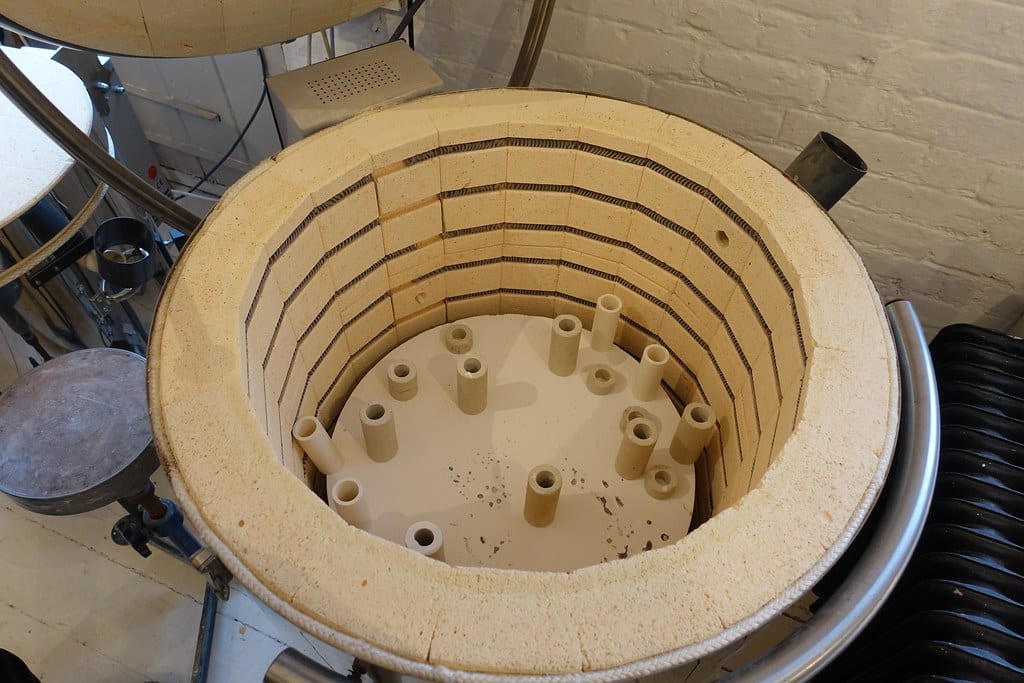
L&L routes its elements through hard ceramic holders that protrude from the kiln wall. The holders have a ceramic tube that receives the element wire; the element slides out of the holder when it needs replacing. Glaze drips that reach the wall hit ceramic instead of a live element.
The practical result: element replacement in the e23T takes around 15 to 20 minutes per element and requires no brick repair. Skutt element replacement takes longer and occasionally requires brick patching if the groove has degraded. For a kiln that will be fired frequently over many years, this maintenance difference compounds.
The electrical picture
At 48 amps, the e23T exceeds the 40-amp continuous-load ceiling of a 50-amp circuit (50 x 0.8 = 40). It requires a dedicated 60-amp circuit. Wire: 4 AWG copper for a 60-amp run.
The outlet question is more complicated at 60 amps than at 50. NEMA 6-50 receptacles are common and widely installed for kilns; they max at 50 amps and will not do for the e23T. A NEMA L6-60R twist-lock is the correct receptacle for a 60-amp, 240V circuit. Many potters have the e23T hardwired directly to the sub-panel rather than using a receptacle at all. Either approach works; the hardwire is more permanent but eliminates plug failure as a failure mode.
Confirm with a licensed electrician before installation. For full details on circuit sizing and voltage drop over longer runs, see our kiln electrical requirements guide.
Garage and home studio placement
The e23T weighs around 340 pounds, which is more than either the KM-818 or KM-1018 and requires the same kind of planning as moving a refrigerator. A pallet jack or appliance dolly with help from a second person is the right approach. Once it is in position, it stays.
The 60-amp circuit requirement is worth evaluating before purchase. In a typical residential garage, adding a 60-amp sub-panel circuit costs $200 to $500 in materials and labor; the exact cost depends on your panel capacity and run length. If your garage already has a 50-amp kiln circuit from a previous installation, factor in the upgrade cost.
For clearance, L&L recommends 12 inches on all sides and 18 inches above the lid. See our kiln ventilation guide for specific airflow needs and kiln placement guide for floor and wall clearance requirements.
What owners report
Potters who chose the L&L e23T over the KM-1027 most often cite three things: the element holder system, L&L’s three-zone temperature control (which lets you compensate for hot or cold spots by trimming individual zones), and a sense that L&L’s overall construction is more robust.
The three-zone Bartlett Genesis controller is a genuine operational advantage for crystalline glazing, raku-style sequences, or any work where top-bottom temperature variation matters. Standard Skutt FireBox programs run one combined program; zone control lets you slow the top ring independently of the bottom.
The 6.7 cubic foot interior is notably larger than the KM-1018’s 4.6 cubic feet but comparable to the KM-1027’s 7.3. Potters coming from a KM-1027 say load capacity feels similar; those stepping up from the KM-1018 notice a significant jump.
Cost to fire
Based on the e23T’s 11.52 kW rating and L&L’s segment duty-cycle method; rate from the EIA, March 2026.
| Firing | Duration | kWh used | Cost at $0.1783/kWh |
|---|---|---|---|
| Bisque (Cone 04) | ~8.5 hr | 51.8 kWh | $9.24 |
| Glaze (Cone 6) | ~14 hr | 86.4 kWh | $15.41 |
| Both combined | ~22.5 hr | 138.2 kWh | $24.65 |
Elements and long-term cost
L&L elements slide out of the ceramic holders without tools. No brick crumbling, no brick repair. A full element set for the e23T runs $150 to $200 depending on the number of elements and the source. L&L sells elements through authorized dealers; Sheffield Pottery and Soul Ceramics both stock them.
The hard ceramic holders themselves are rated for the life of the kiln and rarely need replacement. If a holder does crack from a severe thermal shock event, individual holders are available as parts.
At identical wattage and similar firing schedules, the e23T and KM-1027 will consume comparable elements over time. The L&L advantage is in the labor and difficulty of swapping them, not in how long they last.
Who should buy something else
You want the lower price. The Skutt KM-1027 at comparable wattage costs less and runs on a 50-amp circuit rather than 60 amps, which simplifies the electrical installation in many garages. If the ceramic element holder system is not a priority, the Skutt is worth comparing directly.
Your studio electrical runs on 50 amps. The e23T needs 60 amps. Upgrading an existing 50-amp circuit to 60 amps is straightforward electrically but adds cost. The KM-1027 fits a 50-amp circuit. Our Skutt vs. L&L kilns comparison covers this trade-off in detail.
You want to start smaller. The e23T is a commitment in both price and space. The Skutt KM-818 and KM-1018 are better entry points for potters not yet certain about their volume needs.
Verdict
The L&L e23T costs more than the Skutt KM-1027. It requires a 60-amp circuit where the KM-1027 needs 50. What you get for the premium is a maintenance system that makes element replacement fast and clean, three-zone temperature control for demanding glaze work, and a kiln built with the expectation that it will be serviced repeatedly over decades.
For a potter who plans to fire heavily for many years and wants the lowest lifetime maintenance friction, the e23T is worth the premium. For a potter making a first serious kiln purchase or shopping primarily on price, the Skutt comparison and home studio kilns guide provide the full picture.