Wheels 13 min read
Pottery Wheel Buying Guide: Centering, Drive, and Fit
How to choose a pottery wheel: why motor HP misleads, centering capacity, belt vs direct drive, reversibility, and splash pans, with a verified spec table.
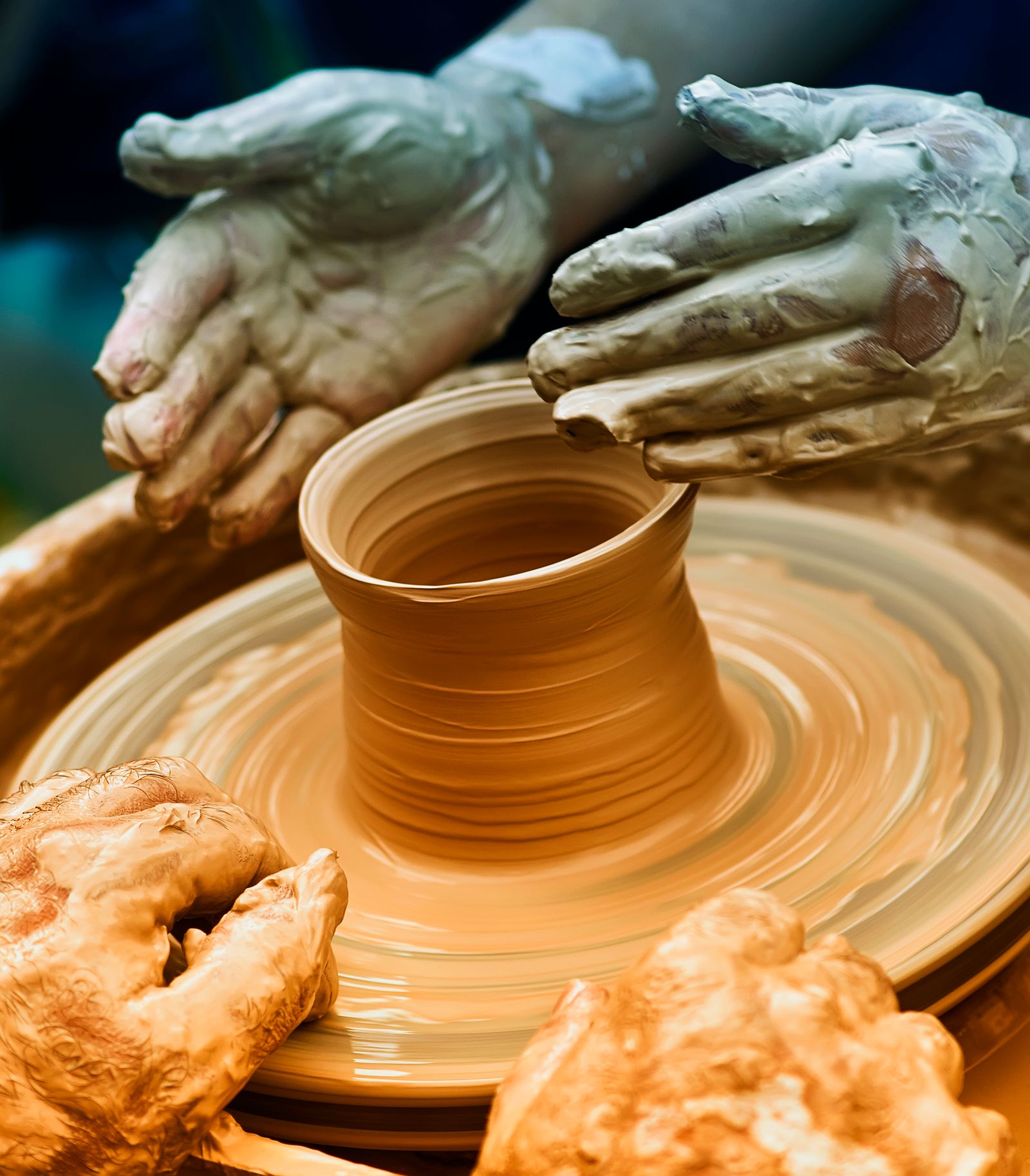
A pottery wheel’s horsepower is the number on the box, and it is the wrong number to shop by. What actually decides whether a wheel helps you or fights you is its centering capacity: how much clay it will hold steady under the pressure of your hands. Those two numbers do not track. Brent’s 1/2 HP Model B is rated to center 150 lb of clay. Shimpo’s 1/2 HP VL-Whisper is rated for 100 lb. Same horsepower, a 50 lb difference, because centering capacity comes from torque and drive design, not raw motor wattage.
So shop the centering number, the drive type, and the wheel-head size. Everything else (splash pan style, reversibility, tabletop versus floor) is a fit decision you can make once you know what you throw. This guide compiles the specs across the wheels actually sold today, then hands you a decision table. Each model below was verified against the manufacturer or an authorized dealer page in June 2026.
Why motor HP misleads on a pottery wheel
Horsepower measures the motor’s peak power output. Centering capacity measures how much clay the whole system (motor, drive, controller) can hold motionless against off-center force at low RPM. That is a torque problem, and torque at low speed is where wheels differ most.
Here is the proof, pulled straight from manufacturer and dealer spec pages. Look at the three 1/2 HP wheels and what each one claims to center.
| Wheel | Motor HP | Claimed centering capacity | Drive | Wheel-head | Reversible | Weight | Warranty | Price band |
|---|---|---|---|---|---|---|---|---|
| Speedball Artista | 1/3 HP | 25 lb | belt | 11 in | no | ~25 lb | 5 yr | $400–500 |
| Speedball Clay Boss | 1/2 HP | 100 lb | belt | 14 in | yes | ~90 lb | n/a | $500–700 |
| Shimpo / Nidec VL-Whisper | 1/2 HP | 100 lb | direct | 14 in | yes | 120 lb | 5 yr | $1,200–1,500 |
| Brent Model B | 1/2 HP | 150 lb | belt | 14 in | yes | ~115 lb | 10 yr | $1,200–1,400 |
| Speedball Big Boss | 1/2 HP | 175 lb | belt | 14 in | yes | ~105 lb | n/a | $700–900 |
| Brent Model C | 3/4 HP | 225 lb | belt | 14 in | yes | 121 lb | 10 yr | $1,400–1,700 |
| Brent CXC | 1 HP | 300 lb | belt | 14 in | yes | ~130 lb | 10 yr | $1,700–2,000 |
Specs verified June 2026 against manufacturer pages (Nidec-Shimpo, Speedball) and authorized dealers (The Ceramic Shop for Brent). One honesty note on the capacity column: makers do not measure it the same way. Shimpo and Speedball publish a “centering capacity.” Brent and AMACO publish what the wheel “handles continuously” (225 lb for the Model C), and AMACO’s own page separately rates the Model C to center 75 lb. So the Brent and Speedball/Shimpo numbers are not strictly apples-to-apples; treat the column as each maker’s own headline figure, not a single standardized test. Price bands are typical US dealer ranges and move with freight; confirm at checkout.
Read across the 1/2 HP row group. Three wheels share the same nominal motor, and their centering claims run from 100 lb to 175 lb. The VL-Whisper and the Clay Boss both sit at 100 lb despite very different prices, because the VL-Whisper’s premium is buying silence and a direct-drive motor, not more centering muscle. The Big Boss claims 175 lb on the same 1/2 HP rating that the Clay Boss uses for 100 lb, which tells you these figures also reflect each maker’s own measurement method, not a shared standard.
The practical takeaway is blunt. A beginner centers 5 to 10 lb at a time. Every wheel in that table clears that by a wide margin. The capacity numbers only start to matter when you throw big: a 20 lb platter, a tall multi-piece vase, repeated production cycles where the motor never gets to cool. That is when a 1 HP Brent CXC earns its 300 lb rating and a tabletop Artista taps out.

Belt drive versus direct drive: noise, torque, maintenance
Two drive systems split the market. Belt drive runs the motor through a rubber poly-V belt to the wheel head. Direct drive bolts the head straight to the motor shaft, with the speed handled electronically.
Belt drive (Brent’s whole range, Speedball’s Boss series) gives strong, stubborn low-speed torque, the kind that resists when you lean into a big lump off-center. Brent’s Model C is a 3/4 HP permanent-magnet DC motor pulling an 8-groove poly-V belt, and that combination is why a 3/4 HP wheel handles 225 lb continuously. Belts are cheap and quick to replace, so the maintenance story is simple: every several years, swap a $20 belt. The cost is a faint mechanical hum you hear at low RPM.
Worth knowing before you wire anything: a pottery wheel is a 120-volt machine. The Brent Model C runs on standard 110 to 120V household power and draws about 7 amps, so it plugs into a normal wall outlet. That is the opposite of the kiln you will eventually pair it with. A studio kiln like the Skutt KM-1027 needs a dedicated 240V, 60-amp circuit, which is the electrical surprise that catches new studio builders. The wheel is the easy half of the setup; the kiln is the half that needs an electrician.
Direct drive (the Shimpo VL-Whisper, now sold under the Nidec banner) removes the belt entirely. Nidec-Shimpo’s own page calls it “virtually quiet; no belts, no vibration,” and that is the entire selling point. The DC brushless motor runs on a magnet system under electronic control, so there is nothing to slip, stretch, or replace. The head doubles as a banding wheel when the pedal sits at stop. You pay for it: the VL-Whisper lists around $1,200 to $1,500, roughly double the belt-drive Clay Boss that centers the same 100 lb.
Which to buy comes down to where the wheel lives and what you throw. Throwing in an apartment, a shared room, late at night with someone asleep nearby? Direct drive, no question. Throwing big in a garage or studio where a little hum is invisible? Belt drive gives you more torque per dollar and a serviceable, decades-long machine. Brent’s belt wheels carry a ten-year warranty and routinely run past 20 years in studios, which is the longevity case for the belt camp.
What owners actually report: the two most-debated wheels
Ask the people who throw on these wheels every day, across the dealer reviews, the owner write-ups (Pottery Crafters, Spinning Pots), and the ceramics forums, and two debates come up more than any others.
The first is whether the VL-Whisper is actually quiet, and owner reports line up with the marketing here, which is rare. The recurring word is “silent,” and the specific claim owners make is that they can throw at night without waking the house, which is the exact use case the direct-drive design targets. The quieter debate inside that one is torque at low RPM: a few belt-drive loyalists argue direct drive feels softer when you bear down on a big off-center lump. The counter, from VL-Whisper owners, is that 100 lb of centering capacity is more than a home potter ever uses, so the question is academic below 15 or 20 lb of clay. Both can be true: belt drive has a torque-feel edge at the heavy end, and almost nobody throwing in a home studio reaches the heavy end.
The second debate is Brent longevity, and it is less a debate than a chorus. Brent’s own motto is “built for life,” and the owner record backs the marketing: the Model C and CXC routinely run past 20 years, and Pottery Crafters notes Brent has built the CXC for over 40 years with owners using single wheels for that long. The thread running through every report is the same: the belt-drive simplicity is the longevity story. There is little to fail, the belt is a $20 swap, and the ten-year warranty is the floor, not the expected life. The dissent is narrow and honest, that the Brent costs more up front than a Speedball Boss wheel of similar capacity, which is true and is the whole reason the budget tier exists. Nobody reports a Brent wearing out early.
Reversibility: who actually needs it
Almost every full-size wheel today reverses, and almost nobody uses it. Wheels spin counter-clockwise by default, which suits right-handed throwers: the clay rotates away from the right hand on the outside wall. Flip the reverse switch and the head runs clockwise, which is what a left-handed potter wants so the clay moves toward the working hand.
That is the whole feature. The Brent range, the VL-Whisper, the Speedball Boss wheels all include a forward-reverse switch as standard. If you throw right-handed, you will set it and forget it. If you throw left-handed, it is the difference between a wheel that cooperates and one you have to fight, so confirm the switch is there before buying. The only wheels that skip it are the smallest tabletops; the Artista, for instance, runs one direction.
Splash pans, wheel-head size, and the rest
A splash pan catches the slip and trim water that throwing throws off. Two designs exist. A removable two-piece pan splits in half so you lift it off the head, dump it, and rinse it in a sink. A fixed pan is molded into the wheel and you sponge it out in place. The two-piece is the one to want: cleanup is the daily tax of wheel work, and a pan you can carry to a sink turns a ten-minute chore into a two-minute one. The Clay Boss and Artista both ship with a two-part splash pan; Brent’s pans are a removable design as well.
Wheel-head size sets your ceiling on width. A 14-inch head (Brent, VL-Whisper, Clay Boss) handles platters and wide bowls. An 11-inch head (Artista) caps the platter diameter you can throw and bat down. For mugs, bowls, and cups, 11 inches is plenty; for anything wide, you want 14. Heads are usually drilled for bat pins so you can pop work off without distorting it, which matters more the bigger you throw.
Tabletop versus floor: the honest tradeoff
Tabletop wheels exist to solve one problem: space. The Speedball Artista is the clearest example. It is a 1/3 HP machine with an 11-inch head, a 25 lb centering rating, and a total weight around 25 lb, so it lives on a shelf and comes out when you need it. Speedball’s own copy says it “can handle 25 lb of clay in a size that makes it easy to throw anywhere,” and that is true within its limits.
The limits are real and worth saying plainly. A tabletop wheel has no mass of its own, so it relies on the table under it to stay put during heavy centering, and it will skitter if you push past its rating. The 11-inch head caps your widest form. The smaller motor and lighter build mean it is a mugs-and-small-bowls wheel, not a do-everything one. If your honest plan is small work in a small space, the Artista is the smallest viable wheel and a good one. If you think you might throw a 15 lb form someday, buy a floor wheel now and skip the upgrade.
Floor wheels (everything else in the table) give you a fixed seat height, a foot pedal positioned for all-day throwing, and enough mass to anchor heavy centering. That is why production potters and serious hobbyists land on a Clay Boss, a VL-Whisper, or a Brent. The tradeoff is footprint and weight: a Brent Model C is 121 lb and does not move once it is placed.
What beginners need versus what studios buy
Beginners over-buy capacity and under-weight the things they will touch every day. A first wheel needs three things: enough centering capacity to never bog down (100 lb is already overkill for a beginner), a 14-inch head so you do not outgrow it on width, and a two-piece splash pan because you will clean it after every session. The Speedball Clay Boss hits all three at the entry price, which is why it is the standard beginner floor-wheel answer.
Studios buy for duty cycle and longevity, not headline capacity. A wheel that runs four hours a day, six days a week, needs a motor that shrugs off heat and a brand with a parts pipeline a decade out. That is the Brent case: belt drive that is trivial to service, a ten-year warranty, and a body that runs past 20 years. A teaching studio buying ten wheels cares more about “still working in 2040” than about a 1/2 HP versus 3/4 HP spec line.
The price bands sort cleanly. Tabletop entry runs $400 to $500 (Artista). The budget full-size floor pick runs $500 to $700 (Clay Boss). The studio-standard belt wheels run $1,200 to $1,700 (Brent B and C). The quiet premium is the direct-drive VL-Whisper at $1,200 to $1,500. Above that, the 1 HP Brent CXC pushes toward $2,000 for production-scale centering most home potters never touch.
Which wheel for which thrower
This is the decision table the spec sheet does not give you. Match the row to yourself.
| You are | Buy | Why |
|---|---|---|
| A beginner in a small apartment, small work | Speedball Artista | 11-in head, 25 lb capacity, stores on a shelf, lowest price. Knows its limits. |
| A beginner with floor space, want to grow | Speedball Clay Boss | 14-in head, 100 lb capacity, two-piece pan, entry price. Won’t be outgrown soon. |
| Throwing late at night / shared walls | Shimpo / Nidec VL-Whisper | Direct drive, near-silent, no belt to service. Pays for quiet. |
| A serious hobbyist who throws big | Brent Model C | 3/4 HP, 225 lb capacity, belt drive, 10-yr warranty. The studio standard. |
| A production potter or teaching studio | Brent CXC | 1 HP, 300 lb capacity, serviceable belt drive, parts a decade out. |
| Left-handed at any level | Any reversible model above | Confirm the forward-reverse switch; skip the Artista if you need reverse. |
Decision matrix compiled by Kiln Shed from the verified spec table above, June 2026.
Once you have a row, go deep on the wheel. Each pick has its own full review, with the long-term owner picture and the spec detail this guide compresses: the Brent Model C review for the studio-standard belt wheel, the Shimpo VL-Whisper review for the quiet direct-drive option, and the Speedball Artista review for the smallest viable tabletop. Read the one that matches your row before you spend the money.
A used wheel is the other path, and for these machines it is a good one. A Brent that has run 15 years has another 15 in it, and the floor wheels rarely die, they just change hands. The risk is a worn belt, a tired pedal pot, or a seized bearing, all cheap and fixable if you know to check them. The used pottery wheel buying guide walks the inspection: what to spin, what to listen for, and what a fair price is by model. Buying used is how a lot of serious potters get a Brent at a Clay Boss price.
One accessory is non-optional whatever you buy: a bat. You throw onto it, then lift it off the head with the pot still attached, so the work never distorts in the move. A 12-inch round bat fits every 14-inch head in the table. The AMACO Plasti-Bat is the obvious match for a Brent, since AMACO builds the Brent wheels, and it fits the rest just as well.
As an Amazon Associate, Kiln Shed earns from qualifying purchases.
Buying the kiln to fire what you throw is the other half of the setup, and it is the half with the electrical surprises. A wheel plugs into the wall; a studio kiln usually does not. Start with the Skutt KM-1027 review for what a real studio kiln costs to run and what circuit it needs before it can turn on.