kiln-reviews 6 min read
Skutt KM-1018 Review: The Mid-Size Studio Sweet Spot
The Skutt KM-1018 gives 4.6 cubic feet of cone 10 capacity on a 50-amp circuit. Verified specs including the wattage Skutt omits, cost to fire, owner reports.
The Skutt KM-1018 fires to Cone 10 in a 4.6 cubic foot chamber on a 50-amp, 240-volt circuit. At Sheffield Pottery (verified June 2026), it starts at $2,923 on sale. For a solo home studio potter who has outgrown a smaller kiln or wants to skip ahead to real production capacity, the 1018 is the kiln most often described as the right amount of kiln.
Here is the number nobody puts on the product page
Skutt lists the KM-1018 by amperage, not wattage. At 39.4 amps and 240 volts, the calculated wattage is 9,456 watts (9.46 kW). That number matters because it is what drives the cost-to-fire calculation.
A Cone 6 glaze firing costs $12.65 in electricity. A bisque costs $7.58. A full bisque-plus-glaze cycle runs about $20.23 at the US average rate.
Specifications
| Specification | Value |
|---|---|
| Interior volume | 4.6 cu ft |
| Interior dimensions | 24” x 24” square, 18” deep |
| Maximum temperature | Cone 10 (2,300°F / 1,260°C) |
| Voltage | 240V |
| Amperage draw | 39.4A |
| Wattage | 9,456W (9.46 kW, calculated) |
| Elements | 4 rings, bifilar |
| Controller | Skutt FireBox (standard); JD-100 digital optional |
| Warranty | 1 year |
| Price (Sheffield Pottery, June 2026) | $2,923 sale / $3,654 regular |
The electrical picture
At 39.4 amps, the KM-1018 needs a 50-amp dedicated circuit. The NEC’s 80% rule limits sustained loads to 80 percent of circuit capacity. On a 40-amp breaker, the ceiling is 32 amps; the 1018 at 39.4 amps exceeds it. A 50-amp breaker allows up to 40 amps of sustained load, which covers the 1018’s draw.
Wire gauge: 6 AWG copper for a 50-amp installation. The outlet is a NEMA 6-50 receptacle, the standard for kiln work at this wattage range.
The KM-1018’s 50-amp circuit differs from the KM-1027, which requires a 60-amp breaker to handle its 48-amp draw within NEC limits (per Krueger Pottery, the authorized dealer spec). Both use a NEMA 6-50 receptacle and 6 AWG copper, but the KM-1027 needs a 60-amp panel slot while the 1018 works on a 50-amp breaker. Full details on calculating your specific run length and voltage drop are in our kiln electrical requirements guide.
Garage and home studio placement
The KM-1018 weighs around 200 pounds fully assembled. It needs a level, non-combustible floor surface and 12 inches of clearance on all sides from walls and combustible materials. A standard garage floor handles it without reinforcement.
Ventilation matters here as much as with any kiln. The larger chamber means more clay body gas and glaze fumes per cycle. A purpose-built downdraft ventilation system or a strongly exhausting window fan keeps the firing environment safe. See our kiln ventilation guide for specific airflow rates and kiln placement guide for clearance requirements.
The 24-inch interior handles platters, tall vases, and sculptural pieces that would not fit in the KM-818’s 18-inch chamber. For most functional ware production, the 1018 loads full without difficulty.
What owners say
Potters who chose the 1018 over the 1027 usually cite one of two reasons: their studio space genuinely cannot fit the 1027’s larger footprint, or the $800 to $900 price difference funded a better wheel or glazing setup. Notes that come up across the ceramics community:
The four-ring element layout heats more evenly than three-ring designs in the same wattage class. Potters doing large glaze loads report fewer cold spots on the bottom shelf when they use three-post shelf stacking rather than four posts.
The difference in interior volume between the 1018 and 1027 is significant in practice. The 1027’s 7.3 cubic feet holds roughly 60 percent more volume per load. For a potter firing twice a week, that difference adds up to several extra loads per month. If your throughput demands it, the KM-1027 is worth the price step.
The digital JD-100 controller is the upgrade most owners add within the first year. The standard FireBox runs preset programs that handle most Cone 6 work without adjustment. Potters working with specialty glazes, crystalline work, or Cone 10 schedules find the programmable controller necessary.
Cost to fire
Based on the KM-1018’s calculated 9.46 kW wattage (39.4A x 240V) and proportional duty-cycle method; rate from the EIA, March 2026.
| Firing | Duration | kWh used | Cost at $0.1783/kWh |
|---|---|---|---|
| Bisque (Cone 04) | ~8.5 hr | 42.5 kWh | $7.58 |
| Glaze (Cone 6) | ~14 hr | 70.9 kWh | $12.65 |
| Both combined | ~22.5 hr | 113.4 kWh | $20.23 |
Elements and maintenance
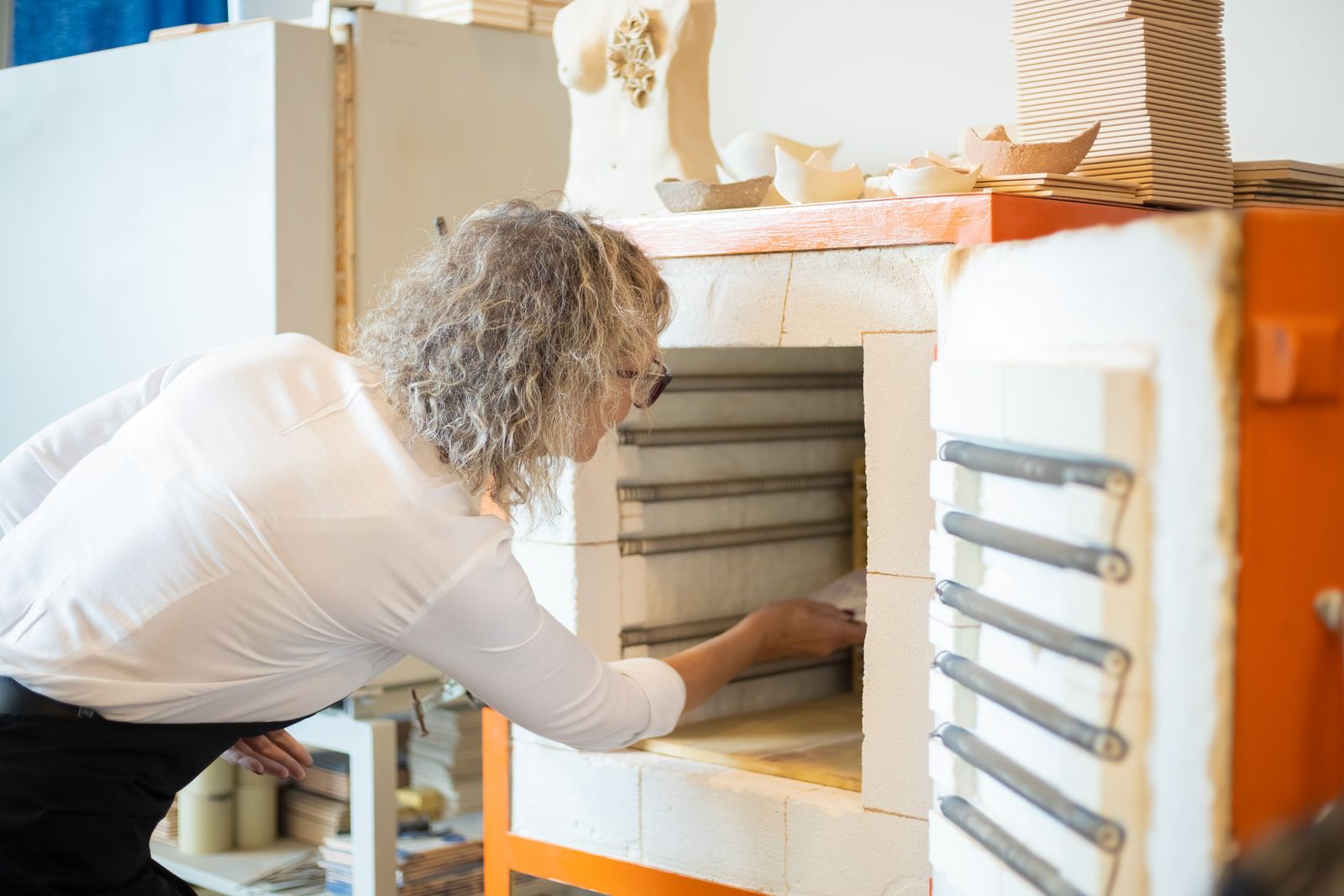
The KM-1018 uses four rings of bifilar elements. More elements and larger interior volume mean each element runs at a lower percentage of its rated capacity per firing compared to the smaller three-ring 818. That slightly lower thermal stress per element can translate to longer element life in equivalent use.
Typical lifespan: 200 to 400 firings at Cone 6, shorter at Cone 10. Signs of wear include extended firing times, uneven temperature across shelf levels, and visible element sagging. A full element replacement kit for the 1018 runs $120 to $150 in parts.
Who should buy something else
You want to grow into wholesale production. The KM-1018 handles serious solo production, but if your goal is a wholesale account or a consistent craft fair presence with large runs, the KM-1027’s 7.3 cubic feet gives you room to scale without adding a second kiln.
You have the space for the 1027 and the budget is close. The KM-1027 costs more, but the price-per-cubic-foot advantage narrows as you compare the two. If your studio can handle the larger footprint, the KM-1027 is often the better long-term investment.
You need 120V operation. Neither Skutt square-body kiln runs on 120V. If your studio space cannot accommodate 240V wiring, the Paragon Caldera is a small 120V option, though it operates in a completely different capacity class.
You are comparing with L&L. At the KM-1018’s 4.6 cubic foot range, the L&L e23T at 6.7 cubic feet is the primary competitor at a higher price point. Our Skutt vs. L&L kilns comparison breaks down the differences in construction, element replacement, and total cost of ownership.
Verdict
The KM-1018 occupies the productive center of the Skutt lineup. At $2,923 on sale at Sheffield Pottery (verified June 2026), it offers substantially more capacity than the 818 on the same 50-amp circuit type and leaves most potters enough room to grow their practice without upgrading again.
The decision between the 1018 and 1027 comes down to how much volume you actually produce. If you are filling a 4.6 cubic foot kiln twice a week, the KM-1027 is the right next step. If you are not sure yet, start with the 1018 and see our KM-1027 versus KM-1018 guide when the time comes to evaluate.