kiln-comparisons 6 min read
Skutt vs L&L Kilns: KM-1027 and e23T Head to Head
Skutt KM-1027 and L&L e23T both draw 48 amps and cost about $15 per cone-6 glaze firing. What separates them: element holders, controller zones, and price.
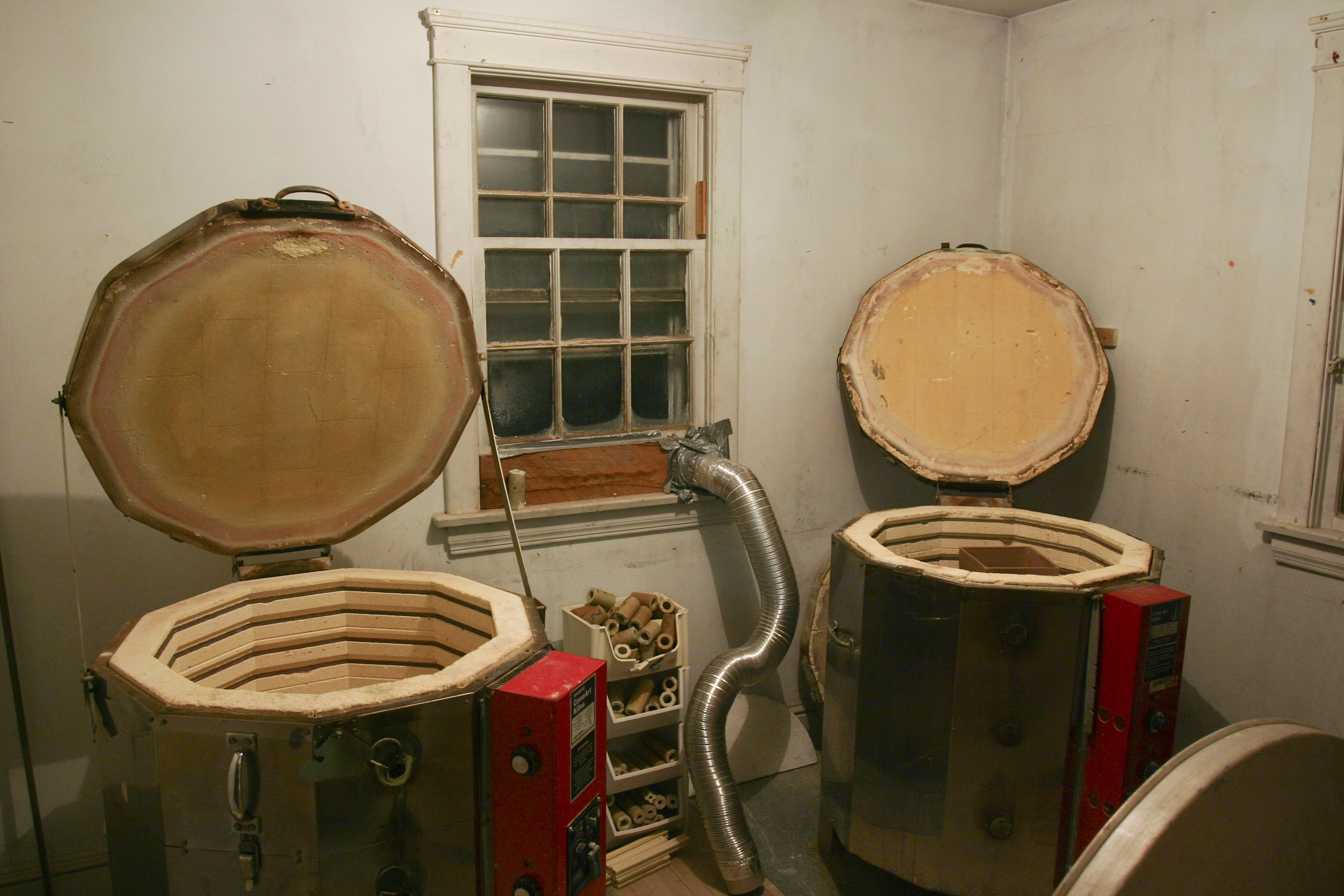
The Skutt KM-1027 and the L&L e23T are the two American studio kilns that serious home potters compare most often. Both draw 48 amps at 240 volts, both fire to cone 10, and both cost $15.41 per glaze firing at the US average electricity rate. The price difference between them runs $1,000 to $2,000. What you get for that premium is a different element design, a different controller, and a longer maintenance advantage that compounds over years of regular firings.
The comparison table
The numbers that matter, side by side. Cost-to-fire figures use L&L’s segment duty-cycle method on each kiln’s rated wattage; rate from the EIA, March 2026.
| Specification | Skutt KM-1027 | L&L e23T |
|---|---|---|
| Interior volume | ~7 cu ft (6.4 cu ft usable) | 6.7 cu ft |
| Interior dimensions | 23” x 23” x 27” deep | 23” x 23” x 23” deep |
| Maximum temperature | Cone 10 (2,350°F) | Cone 10 (2,350°F) |
| Voltage | 240V | 240V |
| Amperage draw | 48A | 48A |
| Wattage | 11,520W (11.52 kW) | 11,520W (11.52 kW) |
| Required breaker | 60A dedicated | 60A dedicated |
| Wire gauge | #6 AWG copper | 4 AWG copper |
| Receptacle | NEMA 6-50 or hardwired | NEMA L6-60R or hardwired |
| Controller | KilnMaster | Bartlett Genesis |
| Temperature zones | Single zone | 3 zones (top, middle, bottom) |
| Element design | Grooves in soft firebrick | Hard ceramic element holders |
| Warranty | 2-year limited (elements excluded) | 1 year |
| Price (June 2026) | $3,500-$4,600 on sale | $5,535 MSRP |
| Bisque firing cost (Cone 04) | $9.24 | $9.24 |
| Glaze firing cost (Cone 6) | $15.41 | $15.41 |
| Full bisque + glaze cycle | $24.65 | $24.65 |
Specs verified June 2026 against Krueger Pottery Supply (KM-1027) and Soul Ceramics (e23T). Pricing from Sheffield Pottery, June 2026.
What is identical between the two kilns
The wattage is the same. That is the fact nobody publishes clearly. At 11,520 watts, the KM-1027 and e23T are the same machine in one respect that matters economically: every firing costs the same. A cone-6 glaze load in either kiln runs 86.4 kilowatt-hours, which at the US average residential rate works out to $15.41. Your electricity bill does not distinguish between the two.
Interior capacity is nearly the same. The KM-1027 measures a few tenths of a cubic foot larger at nominal volume, but Sheffield Pottery lists the KM-1027’s usable capacity at 6.4 cubic feet, slightly less than the e23T’s 6.7. Potters who switch between the two do not report a meaningful difference in how many pieces fit per load.
Both fire to cone 10. Both use digital programmable controllers. Both sit in the same class of machine that a serious home studio needs.
What is different: element design
This is where the two kilns genuinely diverge.
In the KM-1027, elements sit in grooves cut directly into the soft firebrick that lines the kiln wall. Glaze drips that fall from pieces loaded near the wall can reach an exposed element and fuse to it. After repeated firings, the ceramic bond at a fused spot becomes a stress point. Element replacement involves carefully lifting the old coil out of its groove; if the brick around the groove has degraded, small pieces of refractory material can come away with it.
The L&L e23T routes its elements through hard ceramic holders that extend from the wall surface. Each holder is a ceramic tube; the element slides in, the holder supports it, and glaze drips land on ceramic rather than on live element wire. When an element needs replacing, it slides out of the holder without tools in roughly 15 minutes. No brick contact, no crumbling risk.
Over 10 or 15 years of regular firing, the labor difference adds up. Element replacement is not an annual event in typical hobby use, but it is a recurring one. Potters who have replaced elements on both systems describe the L&L process as faster by a factor of two or more, and without the occasional brick repair that can complicate a Skutt swap.
What is different: controllers
The KM-1027 uses Skutt’s KilnMaster controller, a 12-key panel with 32 ramp-hold segments and 12 stored programs. It handles every standard firing schedule and includes current-sensing diagnostics that help identify aging elements. The KilnMaster is not the newest interface, but it is reliable and widely understood in the ceramics community.
The e23T uses the Bartlett Genesis, a touchscreen controller with three-zone temperature management. Zone control lets you trim the top, middle, and bottom rings independently. For most cone-6 functional ware, single-zone firing is sufficient and the KilnMaster handles it without issue. For crystalline glazing, raku-sequence work, or any firing where top-to-bottom temperature variation matters, the e23T’s three-zone control is a real operational tool, not a checkbox feature.
Electrical installation
Both kilns need a 60-amp, 240-volt dedicated circuit. Neither shares with anything else.
The wire gauge differs. Krueger Pottery’s verified KM-1027 spec calls for #6 AWG copper, which is standard for kiln work at this amperage range. The e23T requires 4 AWG copper, which is heavier and more expensive per foot. On a 20-foot run that difference is minor; on a 60-foot garage-to-panel pull it adds meaningful cost to the installation.
The receptacle type differs. The KM-1027 uses a NEMA 6-50, the common 50-amp, 240-volt plug found in studios wired for welders or previous kilns. If your space already has a NEMA 6-50 outlet on a 60-amp circuit from a prior installation, the KM-1027 connects to it. The e23T requires a NEMA L6-60R twist-lock, which is less common in residential installs and typically means a new outlet regardless. Many e23T owners hardwire directly to the sub-panel instead.
An electrician is required for either installation. For the full by-model electrical table, see our kiln electrical requirements guide.
Price and warranty
At Sheffield Pottery in June 2026, the KM-1027 runs $3,500 to $4,600 on sale and the e23T lists at $5,535. The gap is $1,000 to $2,000 depending on which Skutt dealer price you use as the comparison point.
Warranty terms flip: the KM-1027 carries a 2-year limited warranty (elements not included), which is longer than the e23T’s 1-year. On a kiln expected to last 20 years, neither warranty covers the productive life of the machine, but the KM-1027’s 2-year coverage is a better buffer for early manufacturing issues.
Verdict by buyer type
Buy the KM-1027 if your studio already has a NEMA 6-50 circuit, price is a real constraint at anything over $4,000, or element replacement frequency in your use case is low enough that the brick-groove system is not a practical problem. The KM-1027 is the better-value kiln for the great majority of home studio potters. See the full KM-1027 review for owner reliability data and the complete electrical walkthrough.
Buy the e23T if you plan to fire heavily for many years and the element-replacement difference will compound meaningfully, you want three-zone control for demanding glaze work, or your studio can absorb the $1,000-plus premium without a difficult trade-off. The e23T is a better-engineered maintenance system for the kind of potter who thinks in decades. See the full L&L e23T review for the complete picture.
For a broader decision starting from scratch, the first kiln buying guide covers the full landscape, and the kiln cost-to-fire page has the complete per-model electricity cost data.